Antequera's official motto is "el corazón de Andalucía" (meaning, "the heart of Andalucia") due to its central location between the cities of Malaga, Cordoba, Granada, and Sevilla. However, to Ian and I, its motto is "the most random little town where everyone comes to for no particularly understandable reason and where there's nobody here and yet everybody here at the same time".
But before I begin, about last night ... we had the best meal of the trip so far at a tapas place called Eslava (in Sevilla). Only Spanish speaking staff, amazing tapas (more modern style) like pork with roquefort sauce and honeyed pork ribs. But the coolest of all: a poached egg on top of a sweet bread pudding type thing with a spiced fig sauce!

The concert in Sevilla in the middle of the beautiful Jardines del Real Alcazar was absolutely beautiful. We wandered around just as the sun set and eventually found our seats under an orange tree. The artists played "la musica antigua" - old Spanish baroque music (baroque guitar and singing) with the old wall of the Alcazar dramatically lit up behind them. Ian and I still can't believe that something like this only cost 4 Euros to see such a beautiful concert. I'm not usually the biggest fan of Baroque music (its patterns and tone/harmony resolutions are a little predictable for my taste), but I do have to admit that hearing it there was absolutely perfect. It was the most appropriate music for the setting - flamenco was on other nights but I didn't think it would have fit there as well. Again, only 4 euro! Unbelievable.

https://blogger.googleusercontent.com/img/b/R29vZ2xl/AVvXsEhwl6oOt47kSOYQW_V8yoS1kmvNsMcQVt1VMSyAEIAHUEjlLXRuJLNSW2SuDNsKBraoG_OHEEHMnPQ_CIy1Gx0HwdcsnQ7-ZbA0b-89x1-zFXVpESp6W-OTw5f2M_dDCFpVRMt0zMSxZjU/s1600/huevo+sobre+base+de+bizcocho+de+boletus+de+trufa+y+caramelo+de+vino+dulce.-+Eslava.jpg
The concert in Sevilla in the middle of the beautiful Jardines del Real Alcazar was absolutely beautiful. We wandered around just as the sun set and eventually found our seats under an orange tree. The artists played "la musica antigua" - old Spanish baroque music (baroque guitar and singing) with the old wall of the Alcazar dramatically lit up behind them. Ian and I still can't believe that something like this only cost 4 Euros to see such a beautiful concert. I'm not usually the biggest fan of Baroque music (its patterns and tone/harmony resolutions are a little predictable for my taste), but I do have to admit that hearing it there was absolutely perfect. It was the most appropriate music for the setting - flamenco was on other nights but I didn't think it would have fit there as well. Again, only 4 euro! Unbelievable.

Concerts at night in the Jardines del Real Alcazar
http://apartclick-sevilla.com/cms/imageLayer/cache/3dc2ac78725c871907ca37511b2641c2/jardines-alcazar-sevilla.jpg-4d7d8082bdbacef7d6e85e2212df7898.jpeg
We are now in Antequera which is the strangest of the towns that we've been in so far - apparently lots of British retirees and expats have settled here and we even overheard a German family was staying 3 weeks, as well as a Czech family for some time as well. However, I can't really figure out what people come out of their way for here ... I know there's a cool rock formation just outside of town and a flamingo migration lake, but otherwise this town is pretty random (and yet, there are SO many people passing through). Ian says it's all of the day trippers from Malaga, or those driving the "Pueblas Blancas" route to see all of the white-washed Andalucian hilltop towns.

Downtown Antequera (it was silent and empty by day and then by night FILLED with people eating dinner along the sidewalks ... the biggest mystery: where did all these people come from?!). The Alcazaba is in the background at the top of the hill.
My Spanish is coming along well (things are coming back to me and my normal-speed comprehension is getting better!) but just when I think I've got it down, the language has been slowly changing on us as we make our way through the country. As a language nerd, I have to describe this in detail:
Take for example something as simple as "thank you". In the Latin American Spanish we all learn back in the states, it's pronounced "gra-see-as" (what is called seseo pronunciation), but in Madrid, the beautifully soft ceceo kicks in and it's "gra-thi-ahs". Simple enough, right? I got it. But then in Cordoba our host pronounces it "gra-thi-ath" (ceceo on both) and in Antequera it's "gra-thi-a" (no closing sound) - now in Granada it seems to be "gra-see-a" (no more "th" and drop the closing sound). I've also been noticing that people simply say "bueno" or "buen" instead of the full "buenos dias" (good day/hello). Of course, this being Spain, the "vosotros" form of verbs is also used (so pretty compared to "ustedes" in latin american spanish). This, with the local dropping of the final closing "s" sounds leads to phrases like "comeís bien?" (pronounced 'comay-bien' ... "did you eat well?"), as asked by our young waiter after our sidewalk lunch of the day's catch of fresh anchovies and "porro" (formerly understood by myself in Cordoba as my favorite "salmorejo" - why is it called something different one city over? Haha). There happens to be a festival tonight in the park where this little town's restaurants are all setting up tapas booths so we'll definitely check it out around 10pm. Tomorrow before leaving our little rest stop here, we might grab a picnic and climb to the top of the hill where the Alacaba is ...
Weather seems to be nicer down here. Madrid's heat radiated from all of the concrete and stone, combined with the exhaust from all of the cars, but Cordoba was even hotter. As soon as we go into Sevilla, however, we were happily surprised by a steady breeze that we let pass through the apartment. This same breeze is here in Antequera, making the temps much nicer. The name for this wind is "sirocco" and it comes from the Sahara desert in North Africa, reaching southern Europe sometimes at hurricane speeds.
6-31-12, 13:00
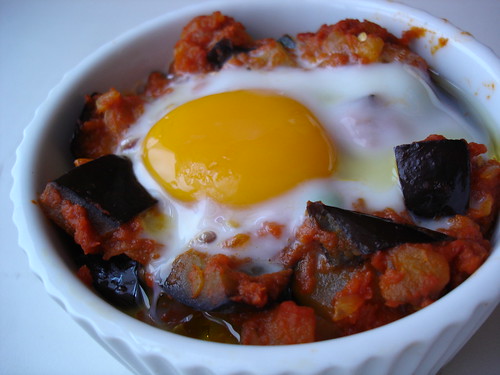
After a nice long siesta, we woke up at 22:00 to walk down to the park where Antequera was having its third annual, week-long tapas y vino feria (festival). We had a fun time wandering the stalls, ordering things off of chalkboards and paper signs that we had no clue about. Some were pleasant surprises like Pisto con Huevo (a mix of roasted veggies - mainly eggplant and red bell peppers - with an over easy egg on top):
Others weren't what I thought, like Adobito ... I had assumed that "adobo" was some kind of stewed meat like in the Filipino "chicken adobo", but it turned out to be some kind of fried battered sour (preserved?) fish. All in all it was fun to fight the crowds to stand at the bars, guess at food, and people watch. Huge turnout for this feria. And it always brings a smile to my face when even in the middle of nowhere in the mountains of Andalucia, you can hear LMFAO's "Party rock" song blasting. That, and Katy Perry on the train.
http://farm2.static.flickr.com/1047/1248535549_14f14d49e7.jpg
Others weren't what I thought, like Adobito ... I had assumed that "adobo" was some kind of stewed meat like in the Filipino "chicken adobo", but it turned out to be some kind of fried battered sour (preserved?) fish. All in all it was fun to fight the crowds to stand at the bars, guess at food, and people watch. Huge turnout for this feria. And it always brings a smile to my face when even in the middle of nowhere in the mountains of Andalucia, you can hear LMFAO's "Party rock" song blasting. That, and Katy Perry on the train.
This morning before we checked out of our hostel, we walked up to the Alacaba at the top of the hill. The view was so quintessentially Andalucian - desert all around the town with olive groves dotting the hills, and then the town, all whitewashed ... the typical Pueblas Blancas image all around.

Being down in the town all day, I never really thought we were in a Pueblas Blancas town, but to my surprise we were! The Alacaba was really interesting, but of course it's the same story of a fortified mosque built under Nasrid/Moorish rule, then captured back during the Catholic Reconquista. What I loved most though was that I saw at most 10 other people, and we were actually encouraged to wander, climb the walls, touch, and experience this fortress. On the way back, we took the back road through the narrow lanes of the locals' residential Antequera, complete with barking dogs and clucking chickens. And now, awaiting the train to Grenada, our last stop in this beautiful southern region before the Catalan coast cities of Valencia and Barcelona
Quintessentially Andalucia ... whitewashed hilltop towns crowned with an old fortress (former mosque, now cathedral)
Being down in the town all day, I never really thought we were in a Pueblas Blancas town, but to my surprise we were! The Alacaba was really interesting, but of course it's the same story of a fortified mosque built under Nasrid/Moorish rule, then captured back during the Catholic Reconquista. What I loved most though was that I saw at most 10 other people, and we were actually encouraged to wander, climb the walls, touch, and experience this fortress. On the way back, we took the back road through the narrow lanes of the locals' residential Antequera, complete with barking dogs and clucking chickens. And now, awaiting the train to Grenada, our last stop in this beautiful southern region before the Catalan coast cities of Valencia and Barcelona


No comments:
Post a Comment