So I had mentioned how we almost missed our train from Madrid to our next city, Cordoba. We took the Madrid metro from Chueca station to Atocha station where we planned to transfer to an AVE high speed "larga distancia" train. Before I continue, a few things: 1) Madrid has the nicest metro trains I've ever seen - they are huge, super clean, and are more like commuter trains than a standard run-of-the-mill subway car. 2) Atocha station is where the 2004 Madrid bombings occurred. It was an interesting feeling to be arriving at this incredibly busy station where the AVE high speed trains and the metro system intersect (the equivalent of Japan's Tokyo metro station). Not so much fear that something would happen, but more of an eerie/pause-for-a-second step back to realize "wow, I'm standing in the exact station where Spain, just a couple of years ago, had its worst attack and loss of life. 10 explosions on 4 huge Cercanias metro trains. Anyhow, we were already cutting it close after getting off of the Metro, but didn't see any signs for our train to Cordoba anywhere on the displays. After wandering about up until 5 minutes before our scheduled departure time, we finally got the nerve to ask for some help. Long story short, we RAN to transfer to the Atocha RENFE (AVE) station - we were in the Madrid metro side of the Atocha station - and made it less than an minute before doors closed. We, or at least I, learned our lesson instantly - our shyness from that point was largely thrown out the window. I lost much of my apprehension/ego about speaking imperfect Spanish (for God's sake, I haven't studied Spanish in nearly 10 years), and have since found getting around to be much easier. I've also found that speaking Spanish (even imperfect) to others from the start is much better understood and accepted than asking if the other party speaks English (even if you ask en espanol).


not my image: http://cdn.c.photoshelter.com/img-get/I00009xHcMTMDcmk/s/850/680/spain-jaen-olive-groves-cesp-00317.jpg

After flying by the dry countryside for a couple of hours on awesome RENFE high speed rail, we arrive!
Upon our arrival, we took the local bus through the winding, narrow cobblestone streets (how did the bus even fit?!) before being dropped off near our host's house. Ian rang the old brass bell, we second-guessed if we had the right location for just a second, and then Marianne opened the door for us and greeted us with the warm two-kiss Spanish greeting (three times in France). "Hablas espanol?" she asked, and this time, unafraid, I replied "si, un poco, pero comprendo mas que hablo!". She explained in her beautiful, soft but passionate Andalucian Spanish all about the house and its history. There was a huge brown wood front door to the street, but then just inside, a small 3x4 meter landing before a metal gate (this was inside the house). The reason, we were told, is because when Muslim pilgrims came to Cordoba in the past, one had to give them shelter (a tenant of Islam). Considering the heat in this part of Spain, I completely understood - without shelter, one would die of heat exhaustion. Beyond the gate was a courtyard open to the sky above, the doors to our room off of the courtyard, and beyond yet another set of doors, the stairs and rooms of the other 4 floors of the house where Marianne and her family lived. Marianne's daughter Christina spoke English and gave us some suggestions for things we ended up doing (and loving) in the quaint, historic town: tapas across the street (at Sociedad de los Plateros) to try traditional Andalucian specialties, walking along the Guadalquivir river at dusk to see the birds coming back, a stroll across the ancient roman bridge with the skyline of the old mosque, cathedral, and town lit up as the sun set, etc.

Where we got off the bus ... we would later find out this house (right across from Marianne's) has been here since the 12th Century!


Inside Marianne's beautiful home ... the front wooden door, and the alcove with the iron gate (foreground) so that hosts could fulfill their obligation to pilgrims without having to let them wander around their entire home.

Look at the beautiful Andalucian mosaic tile work

Door bell is literally a bell

Interior courtyard shaded with sails above

The streets of Cordoba ... not my image http://farm8.staticflickr.com/7210/6926382445_29ee70a790_z.jpg
We visited the incredible Alcazar of the Christian Monarchs (one of the many residences of the kings), wandered the extensive gardens with their genius channel irrigation system by afternoon, and took a small night tour of the Great Mosque of Cordoba at night.


So freaking hot ... yes, even by my raised-in-the-southwest-desert standards! But the fact that nobody was around made it worth it


Although Cordoba is actually a pretty large city of more than 300,000, I felt like it was a small town since hardly anybody was around this time of year

Stunning examples of Moorish architecture. Cordoba was the capital of the Islamic caliphate (Ummayad?) for quite some time

After a quick break in the shade to avoid the heat (now I understand the siesta completely), we headed out to the Alcazar de los Reyes Cristianos (the Alcazar of the Christian Kings). Despite the name, the fortification was formerly under the Islamic empire, then renamed after the Reconquista by the Christian monarchs:


Man, I love mosaics!

Roman ruins within the Alcazar

More mosaics!


Few more tourists at this spot, but still I'd say less than 10 people ... amazing to have such a peaceful experience in the kind of environment that was, in my head, quintessentially "Spanish".

Can't believe we get to walk around on the walls!

In the gardens, more genius engineering from back in the day. Irrigation channels that could be diverted to water different plots in the garden!

In the gardens of the Alcazar. My heart is fluttering ... this is exactly why I wanted to come to southern Spain's Andalucia region - for architecture and the "feel" of places like this :)

Still in use today ... diverting the water within different channels to water the plants

Then it was time for lunch at the place right across the street from Marianne's ... Sociedad de los Plateros for a taste of the recommended, local food that originated here in Cordoba and spread elsewhere in Andalucia! (We would end up eating here for dinner too again because it was so good!) There's nothing I love more than really experiencing the local food specialities. We even saw Marianne come in from her home 10 feet away to read the paper, chat with local friends, and enjoy some bites:

THE BEST TOMATO SALAD I'VE EVER HAD ... I can't believe how much flavor those tomatoes have! And the local olive oil! And a touch of salt!

Salmoreja ... THE local specialty! Puree of tomatoes, garlic, olive oils, and breadcrumbs with jamon and hardboiled egg

Marianne's list of recommended local foods to try here

Tortilla de patatas ... not like the Mexican tortilla. Torillas in spain are more like thick egg tarts. We were told to eat this with the salmoreja together to really look like a local in the know ;-)
 berenjenas con miel (fried eggplant with honey), not my image: http://cache.virtualtourist.com/4/3493609-Berenjenas_con_miel_Malaga.jpg
and flamenquin (pork chop wrapped with ham and then fried, served with mayo and fries). not my image: http://i.ytimg.com/vi/N38eqIxCJfw/0.jpg
Cheap, unbelievably delicious, and a relaxed atmosphere ... it was 100% a local's place, filled even at 1AM. At lunch earlier in the day we also had a tomato salad made simply of sliced local tomatoes, olive oil, salt, and dried herbs - I will never get over how red and rich the tomatoes were, how flavorful the olive oil was (I'm sure it was locally produced), and how simple it was.
All fueled up and ready for more walking around ... this time to the Great Mosque.

Again, my heart fluttering. This is the architecture I wanted to see here in the south.


The courtyard of the Great Mosque

More smart plant watering planning :)

The peaceful trickle of the cool fountain in the middle of the blazing afternoon echoing off of the stone ... orange trees all around. Locals stopping by to fill their water bottle, napping in the shade. This is Andalucia.

Nobody around ... all to ourselves

More orange trees all around town and white-washed buildings.

Such smart city design. We learned that in hot southern Andalucian cities, building tall structures close together means that the narrow streets are always shaded from the hot sun. Painting the buildings white also helps, as do these beautiful cloth sails.

Beautiful! And useful!

Royal Music School of Cordoba

All to ourselves ... don't you see this kind of picture in postcards or magazines? But it's real :)
After a late siesta in the afternoon, we returned to the Great Mosque for the night tour which was incredible. So quiet and far fewer people are allowed to do the night tour, so it was an intimate way to see the inside with an audio guide, music, and lights.
Walking the roman bridge over the Guadalquivir before the night mosque tour:


Arches of the great mosque, not my image: http://schools.nashua.edu/myclass/lavalleev/Art%20History%20Pictures/ch13/13-11.jpg
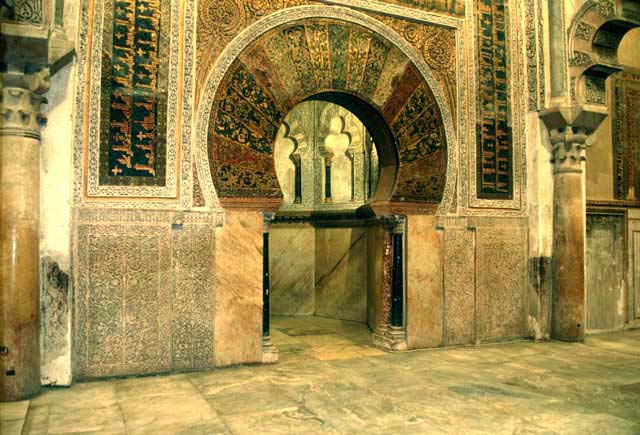
The GORGEOUS mihrab of the mosque. not my image: http://classes.colgate.edu/osafi/images/great%20mosque%20cordoba%20mihrab.jpg
There was the cathedral side of the building as well, with its amazing carved choir stands from New World wood, but I thought the Islamic art was much, much more impressive. It's why I wanted to come to Andalucia ... I can see cathedrals anywhere, I can't find incredible Moorish influenced architecture like this elsewhere. Still, it was so cool to see how after the Reconquista by the Christians, minarets where Muslims were called to prayer were replaced by bell towers, Mirhabs stand next to altars, etc.
This morning we had breakfast in the garden before bidding farewell, and we were off to Sevilla - this time with no fear or embarrassment about speaking with others to make sure that we were in the right place to catch the right train. A quick one-hour trip passing miles of orange/lemon trees and fields of sunflowers (seeds pressed for oil), and we were in Sevilla - the capital of Andalucia, and back amongst the rush of cars and bustle of a big city (Cordoba, by contrast, is very small with narrow cobblestone streets everywhere. The tall, narrow alleyways maximize the shade to keep us cool, as did the whitewashing of the buildings. Cordoba also has many more gorgeous flower-filled patio courtyards and once a year there's a huge competition to see who has the prettiest).
Our apartment here in Sevilla has old balcony doors opening to overlook the gardens of the Alcazar (yes, another one). We got off to an early start and simply walked around everywhere, taking it easy today.

On our way to Sevilla ... love the Spanish train system. 2nd most punctual high speed rail in the world, after Japanese shinkansen bullet train!

Our apartment here in Sevilla! Right across from the Alcazar (Moorish fort)


The grand cathedral

Bullfighting ring ... not in season when we went


Granizado! Save my life in this heat! Phewwww

Plaza de America ... stunningly beautiful, and a local just decided to play Spanish guitar in the shade. Nobody else around, the trickle of water, and the sound of a guitar softly strummed ...

Built to commemorate the Iberian-American exposition of 1929. Each of the "spots" around the ring are dedicated to a different city in Spain


The building still very much in use by the government ... economic and business ministry based here. After all, Sevilla is the capital of Andalucia

Orange trees all over town ... like, EVERYWHERE! Not my image: http://images.travelpod.com/users/lar4290/11.1212965100.sevilla-orange-tree-in-shopping-district.jpg
Makes sense, considering it seems nearly every tree in town is an orange tree!
Dinner at Eslava ... we took a cab across town. Taxis in Spain are very cheap (some people even use them to run errands and grocery shop), the drivers are always honest (they are also highly monitored by the government), and very friendly. I believe I read somewhere there are more taxis per capita in Spain than anywhere else. So convenient and cheap. We happened across Eslava after doing some research ... this is a Spanish-speaking only tapas place, but very well known here. Foreigners have started to catch onto the spot, but tend to eat earlier while the Spanish crowd comes much later in the evening. We opted for an early dinner before the concert tonight....
Don't ask me to remember the names of these things ... I can simply say they were AMAZINGGGG


Foodie heaven!

Post-dinner walk about town. Sevilla is definitely a big city!


Inside of the gardens at the Alcazar ... ready for the concert tonight

In an hour ... old baroque Spanish music with the sun set and the Alcazar lit up behind. Incredible to hear such beautiful music in the middle of these walls. It was as if we were transported back in time.
Tomorrow: Antequera.


No comments:
Post a Comment